This Ancient Rome Word Search puzzle is a hard one! With a larger grid and more words to find, it’s more challenging than our popular Greek Mythology Word Search puzzle or Ancient Greece Word Search. Difficult word find puzzles can help kids master harder spelling words and concepts, but they can also help adults exercise their brains. Solving hard word searches is also rewarding and relaxing, so give it a try on a rainy day or in your humanities’ classroom. Maybe you’re in the mood to color instead? Try our Greek Mythology Coloring Pages!
Click on the image below to download your free printable Ancient Rome Word Search puzzle!
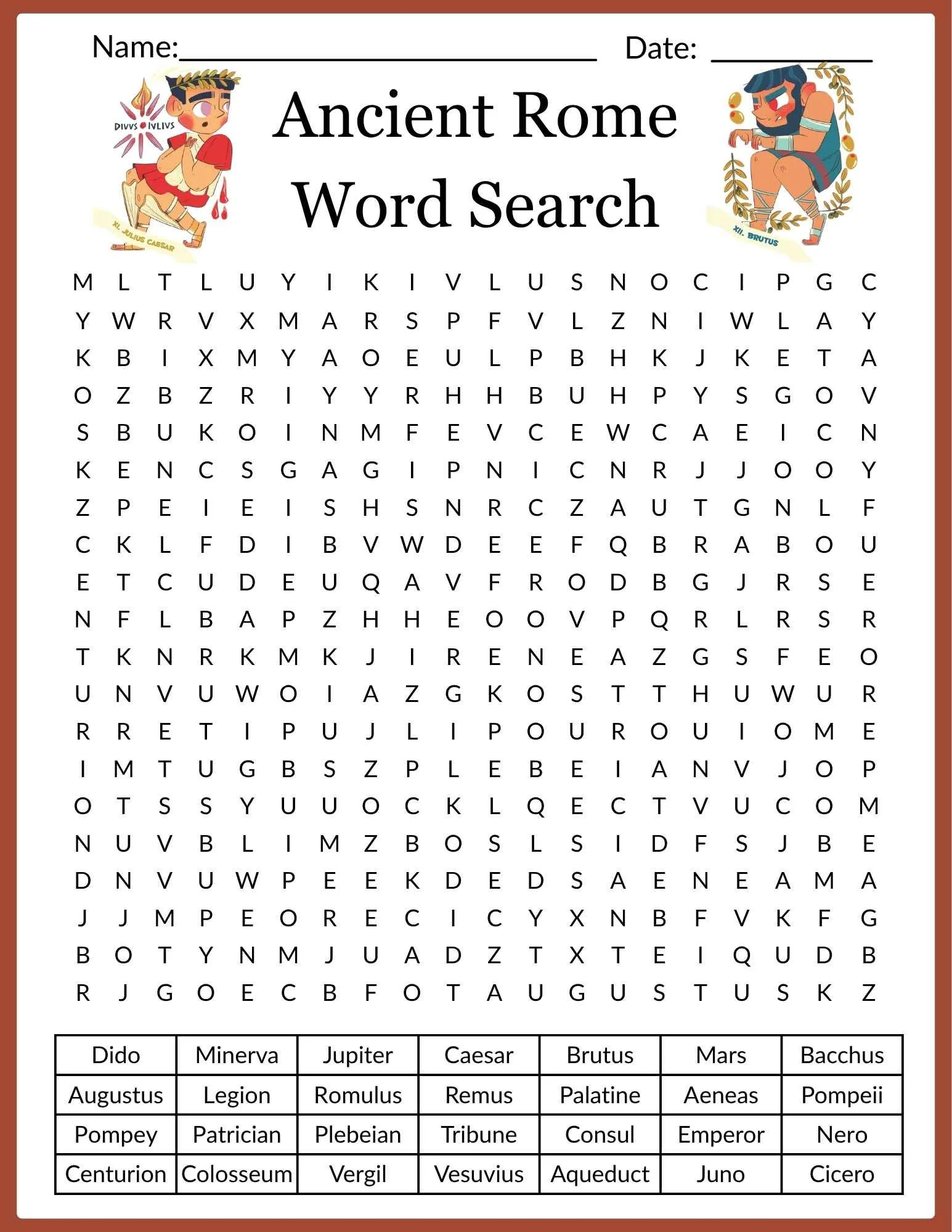
Hard Ancient Rome Word Search puzzle from The Classical Workshop
Ancient Rome Word Search Rules
This is a hard level word search puzzle. What does that mean?
The game grid is 20×20
There are 28 challenging words to find
Words can be spelled forward or backwards
Words may go vertically, horizontally, or diagonally
Look out for tricky false-starts and combinations of letters meant to draw your attention!
Ancient Rome Word Search Puzzle Answer Key
We won’t spoil the puzzle by posting a picture of the answer key here, but once you’ve given this more difficult word find puzzle a try, check your answers with the Ancient Rome Word Search answer key!
Guide to Roman Names and Places in this Word Search Puzzle
Pompey: Pompey the Great was Julius Caesar’s rival in the Roman Civil War. He was called “the Great” because he rid the Mediterranean of pirates.
Patrician: The higher of the two social classes of ancient Rome. Often called “nobles,” or “aristocrats.”
Plebeian: The lower of the two social classes in ancient Rome. Often called “commoners.”
Tribune: An important position in Roman government, especially during the Republic period. The Tribunes represented the interests of the Plebeian class.
Consul: The highest position of authority in the Roman government. There were two, which prevented the rise of tyranny, but also occasionally caused trouble.
Emperor: After the end of the Republican period, Rome was ultimately under the authority of one person: the Emperor.
Nero: One of the most notorious emperors of Rome, who is thought to have practiced his lyre while a fire destroyed the city. Thus the famous saying, “Nero fiddled while Rome burned.”
Centurion: An experienced veteran and leader in a legion. These soldiers were highly respected by their subordinates.
Colosseum: The Colosseum played host to a number of games and entertainments, and could even be flooded to host mock naval battles.
Vergil: The author of the Aeneid and Rome’s Homer. Or was he a propagandist for Augusts?
Vesuvius: A volcano that erupted and destroyed the city of Pompeii.
Aqueduct: Infrastructure was one of Rome’s greatest strengths, and their aqueducts are one of the best examples of that. Some still carry water today!
Juno: The queen of the god’s and Jupiter’s consort. The Greeks called her Hera.
Cicero: A Roman statesmen who used his oratorical ability to defend the Roman Republic.
Dido: The mythical first queen of Carthage, Rome’s greatest rival.
Minerva: Jupiter’s daughter, and the goddess of crafts. Greek Athena.
Jupiter: King of the gods, he wields the thunderbolt and brings order to the cosmos. He’s Zeus to the Greeks.
Caesar: Julius Caesar was a military genius and author of several important historical accounts.
Brutus: One of the assassins that attacked Julius Caesar in the Curia of Pompey.
Mars: The Roman god of war. The Greeks called him Ares.
Bacchus: The Roman god of wine. The Greeks called him Dionysus.
Augustus: Julius Caesar’s nephew and heir, and the first emperor of Rome. The month of August is named after him, but his given name was Octavian.
Legion: The main unit of organization in the Roman military. Its specific size varied throughout history, but was often several thousand men supported by a variety of light troops.
Romulus: The founder of Rome, and Remus’s brother. Rome is named after him.
Remus: Remus was Romulus’s brother. Romulus murdered him when Remus jumped over the half-finished walls of Rome.
Palatine: The Palatine Hill is the most central of the Seven Hills of Rome. It held great significance in antiquity and was the site of palaces.
Aeneas: The hero of Vergil’s epic poem the Aeneid, often thought of as Rome’s Odyssey. Aeneas was a Trojan that escaped the destruction of Troy with his father. He had a relationship with Dido that led to the eternal animosity between Rome and Carthage.
Pompeii: A city destroyed by Mount Vesuvius in 79 BCE. The disaster was reported by a Roman named Pliny the Younger, whose uncle, the aptly named Pliny the Elder, died trying to rescue people.
Need More Classics Activities for your Kids or Classroom?
The Classical Workshop has you covered with free Mythology Coloring Pages and Ancient Greece Word Searches. All of our educational kids’ games are made in United States, so you can be assured of quality and safety. Take on the gods in a game of memory match with Mythology Match: A Memory Game, or challenge Caesar himself to a game of Go Fish with LUDI! Classic Card Games for Kids. Explore ancient civilizations with our 48 Piece Minoan Dolphins Puzzle! And, for the smallest scholars of all, check out our High Contrast Board Book for Babies: The Mountains Are Sleeping!
The Muses are always hard at work on Mount Parnassus making new activities and coloring pages. Be sure to follow our blog to stay up-to-date with new products, sales, and freebies!
Ready to Learn More About Ancient Rome?
There are lots of other resources available for teaching kids about ancient Rome! Kids who want to learn Latin, the language of ancient Rome, will want to check out Legonium. Legonium teaches Latin with the help of every kid’s favorite toy: LEGOS!
Does your kid like to perform? Check out Disney music sung in Latin by ScorpioMartianus on Youtube! These are real covers-not AI.Hearing Latin come to life if fun for anyone, but it’s especially fun when it’s this catchy.
DK’s educational books about ancient civilizations are always a hit with older readers. High-quality pictures and carefully researched facts fire kids’ imaginations and inspire them to learn more. Our own kids love these, and I can’t say enough good things! Millennials will recognize and love the Utopian Scholastic aesthetic.
Looking for an adult’s history of Rome? Mary Beard is one of the best known classicists in the world, and her book SPQR is a good choice for adults looking to learn more about Rome.