
Need an Ancient Greece Word Search puzzle? Whether you’re looking for a rainy-day activity or a classroom resource, we’re here to help with another Ancient Greek word search page. Once you’ve finished this one, be sure to have a look at our related Greek Mythology Word Search. Don’t miss our collection of Greek Mythology Coloring Pages featuring gods, monsters, and heroes!
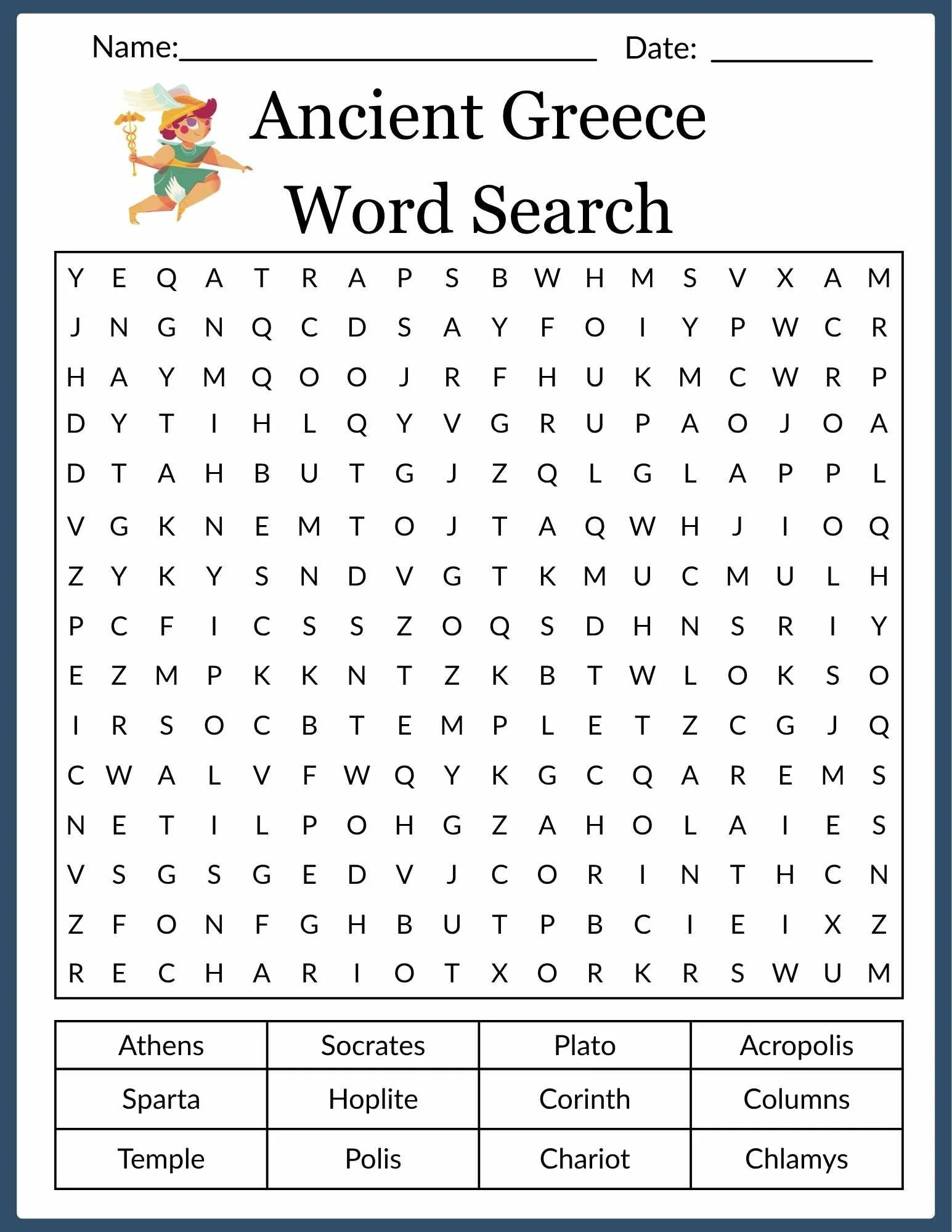
Ancient Greece Word Search Puzzle from The Classical Workshop
Ancient Greece Word Search rules
This is an intermediate level word search puzzle. What does that mean?
The grid is 18×15 squares
Words may appear horizontally, vertically, and diagonally
Words may be reversed
Ancient Greece Word Search answer key
Was this word search a bit more tricky? Once you’ve given it your best effort, you can find any you missed with the Ancient Greece Word Search answer key. We won’t post a picture and spoil the fun!
Wondering about the Ancient Greek names featured here?
This printable puzzle features important people, places, and things from Ancient Greece. What are they? There’s a brief description here, but clicking on each name will take you to modern, illustrated resources for each concept.
Athens: One of the greatest city-states in Hellas-which is what the ancient Greeks called the area that is roughly modern Greece. There was no actual “Greece” in classical antiquity. The different city states governed themselves, though occasionally they came together for “Panhellenic” events that included all the Greeks.
Sparta: Another great city-state and the chief rival of Athens in the classical period. Sparta was known for its great military prowess and still is today. Books, comics, and movies like 300 still perpetuate the idea that the Spartans were great warriors, largely because of their role at the famous Battle of Thermopylae.
Corinth: Another prominent city-state of ancient Greece. It sat on the isthmus that connects the northern and southern parts of Greece, which made it very important for trade.
Polis: A Greek word that means “city.” Today, we often use it when talking about ancient Greek cities as they existed as independent city-states. The plural is poleis.
Acropolis: A Greek word that literally means “high city.” In ancient Greek cities, it was a place on a hill that served both religious and defensive purposes. In Athens, it was the home of the temple of Athena Parthenos, or Athena the Maiden. Try a coloring page of Athena Parthenos, inspired by our relationship with The Nashville Parthenon!
Socrates: One of the great philosophers of Athens. He liked to ask people questions that seem simple, but were actually very difficult to answer. The Oracle at Delphi called him the most intelligent man in the world-because he was the only one who recognized how little he knew!
Plato: A student of Socrates who wrote the famous philosophical work The Republic. In it, he considered what an ideal city would like. He names it the Kallipolis-The Fine City!
Hoplite: In the ancient world, there were few standing armies. Ancient Greek armies of “hoplites,” or citizen-soldiers who provided their own equipment, would form as needed to fight on behalf of their city. They are named after their heavy shield, which was called a “hoplon.” It was impossible to run away from battle effectively while holding a hoplon, so soldiers who returned from war without a shield were often shamed. One mercenary, named Archilocus, was unconcerned with their opinions, and wrote this poem:
“Some Saian enjoys my peerless shield, which I, all unwilling, cast away beside a bush.
Still, I saved myself. What do I care about that shield?
Forget it. I’ll get a new one, no worse.” My own translation of Archilocus fr. 5!Columns: Columns were an important part of Greek architecture, and not just because they held the roofs up. They became expressions of artistic beauty in their own rights, with a variety of capitals called Doric, Ionic, and Corinthian.
Temple: Important sites of religious worship for the ancient Greeks. Temples could be places of healing or places where people looked for oracles and predictions about the future.
Chariot: Not exactly the most practical way to get around the mountainous region of ancient Greece, where the roads were shoddy at best. They made for excellent race cars though!
Chlamys: Ancient clothing is a very interesting topic, which will have to get its own set of puzzles and features in a future blog post. The chlamys itself was a short men’s tunic, typically made of wool. It was made of single piece of fabric that was then wrapped about the body and pinned to stay in place.
Need more classics for kids?
The Workshop has you covered! Make sure to follow our blog for to be the first to know about new educational books, games, and floor puzzles for kids, along with new mythology coloring pages, word searches, and feature articles. Submit your completed coloring pages at submissions@theclassicalworkshop.com so we can feature them on our social media!
Learn More about Ancient Greece with Greek Mythology Memory Match
Are you introducing your young scholars to the world of Ancient Greece? Classical learning is easy with games like our Greek Mythology Memory Match game, Mythology Match!
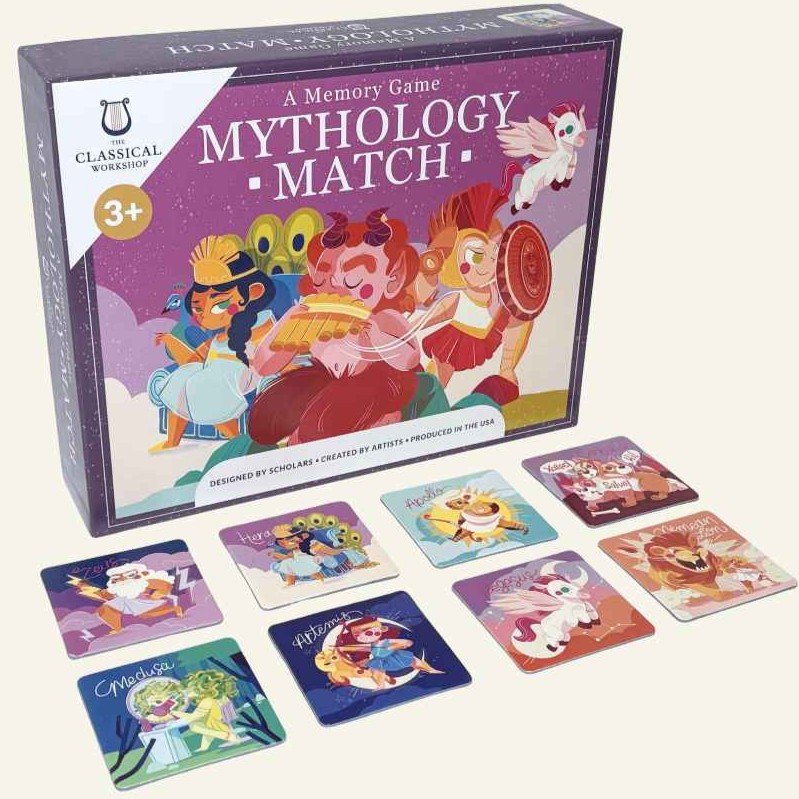
By the gods! Mythology Match: A Memory Game will bring the world of ancient Greece to your next family game night. The rules are simple and the games are quick in this fast-paced, memory-matching, tile-flipping card game!
Memory games for kids are an easy way to help young scholars build important early-learning skills like focus, concentration, and problem solving. Charming illustrations packed with cute characters give parents lots of options to tell stories and introduce kids to the major figures of Greek mythology. Learning is effortless with Mythology Match: A Memory Game and The Classical Workshop!
Premium memory match set includes 24 pairs of tiles printed on 80pt puzzle board
Simple rules and quick gameplay make this the perfect family game for family night
Designed by teachers to develop important skills and introduce kids to Greek mythology
Manufactured entirely in the USA
