
Educational Game Guide
LUDI! Classic Card Games for Kids


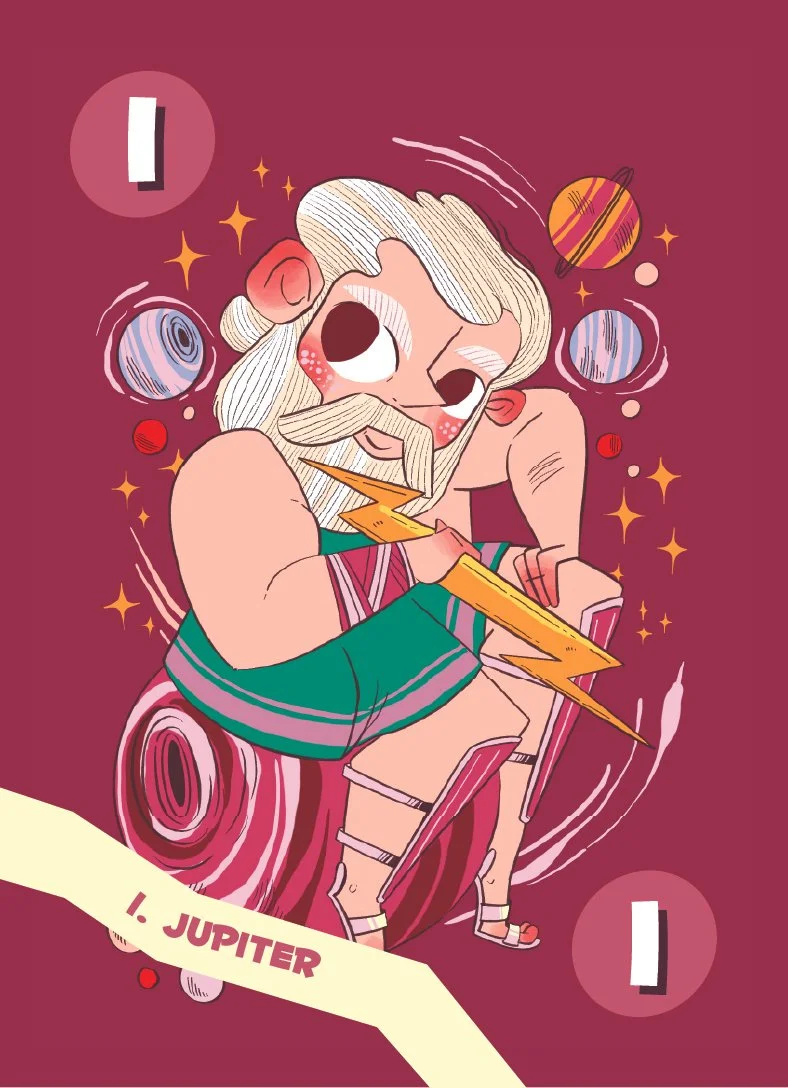
Jupiter, King of the Gods
This is Jupiter, the King of the Roman gods, and as such he deserves his place as the first card in the deck. Just like Greek Zeus, he wields the thunderbolt and is responsible for bringing good order to the universe.
Unlike Greek Zeus, Jupiter was worshipped in Rome as part of the “Capitoline Triad,” which was a group of three gods: Jupiter, his wife Juno, and his daughter Minerva. They were often depicted together in statues and other art.
Jupiter had a lot of different epithets (it means nicknames), but his favorite was probably “Jupiter Optimus Maximus,” which means, perhaps obviously, Jupiter Best and Greatest.
Jupiter has made his way into our everyday speech in a few ways. The planet Jupiter, largest in our solar system, is named after this god. If you’ve ever heard the phrase, “by Jove!” then you’ve heard a subtle reference to Jupiter.
Final fact: Latin doesn’t use the letter j, so in Latin his name is “Iupiter.” Find pronunciation here:
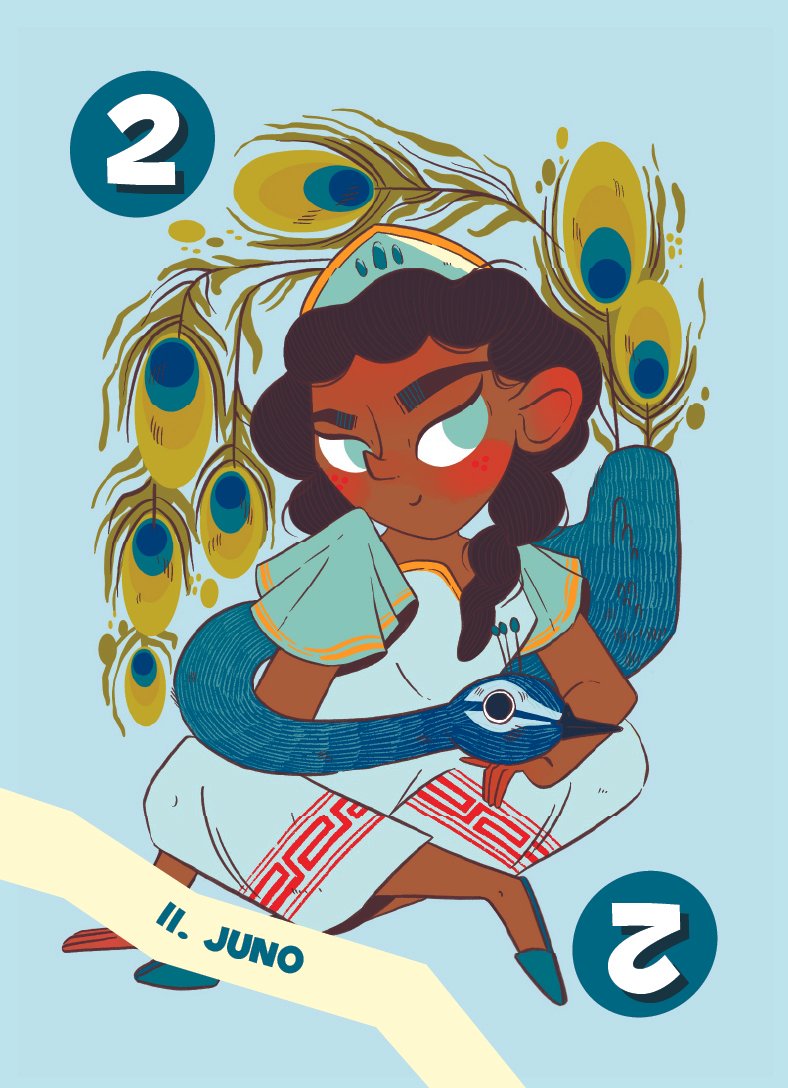
Juno, Queen of the Gods
Juno was the Queen of the Gods and Jupiter’s wife. She protected the women of Rome and looked after them in marriage and childbirth. You may be more familiar with Juno as the Greek goddess Hera, who held a similar place in the Greek pantheon of gods. Like Jupiter, she is a member of the Capitoline Triad.
In his famous poem the Metamorphoses, the Roman writer Ovid tells us how Juno came to be associated with the peacock. She had a servant named Argus whose body was covered in eyes. His eyes never went to sleep all at the same time, so he made an excellent watchman. He ran afoul of Hermes, though, and after his untimely demise Juno put his eyes in the tail of the peacock as a tribute. This is part of the story of Io, and you can read more about that here (parental guidance suggested): https://www.theoi.com/Heroine/Io.html.
If this story seems familiar, it may be because of the name “Argus.” Argus Filch is the caretaker of Hogwarts Castle in the Harry Potter series who is often a minor antagonist. Thanks to his cat Mrs. Norris, who spies around the castle and reports back to him, he has an extra set of eyes-though he’s still about 96 short of his namesake.
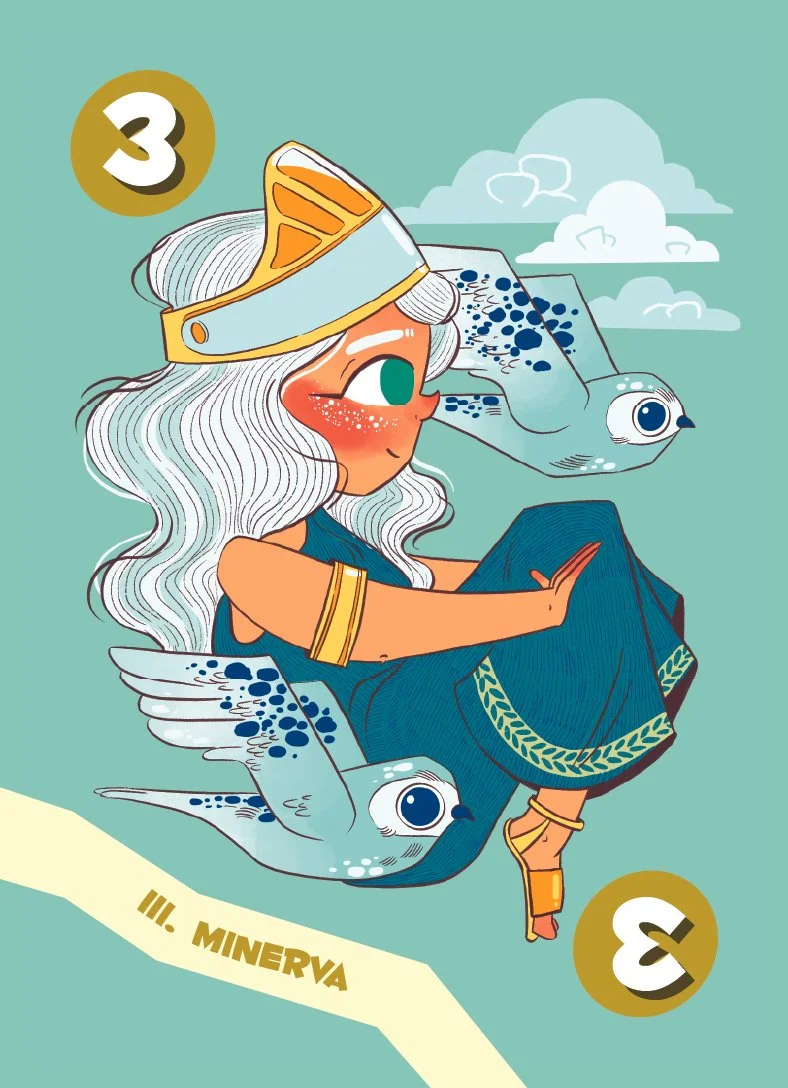
Minerva, Goddess of Wisdom
Behold Minerva, the final member of the Capitoline Triad and the daughter of Jupiter himself! That is, she is the daughter of Jupiter alone. The story goes like this: when Jupiter developed a splitting headache, nothing at all could help him. He eventually asked Vulcan, the god of the forge (the largest cast iron statue in the world is of Vulcan, and is in Birmingham, Alabama) for help, and Vulcan tried relieving the pain by splitting Jupiter’s head with an axe. Minerva sprung forth from Jupiter’s head, wearing a full set of armor and holding her spear, and Jupiter’s headache was cured.
Minerva was known to the Greeks as Athena, and, having come directly from Jupiter’s head, was a goddess of wisdom and craft. She was the goddess of victorious warfare-distinct from her brother Mars, who was simply the god of war-but she was also associated with all kinds of crafts. When the weaver Arachne bragged that she could weave even more beautifully than Minerva, Minerva took it personally. They had a contest, and when Arachne refused to admit that the goddess had won, Minerva turned into her into a spider so she could weave forever. Read more about Arachne here: https://www.theoi.com/Heroine/Arakhne.html
Final fact: Minerva’s bird is the owl, and we’ve come to associate it with wisdom and learning. However, her bird was originally the crow, a bird that is actually intelligent. The crow couldn’t keep a secret, though, and was replaced by the owl.
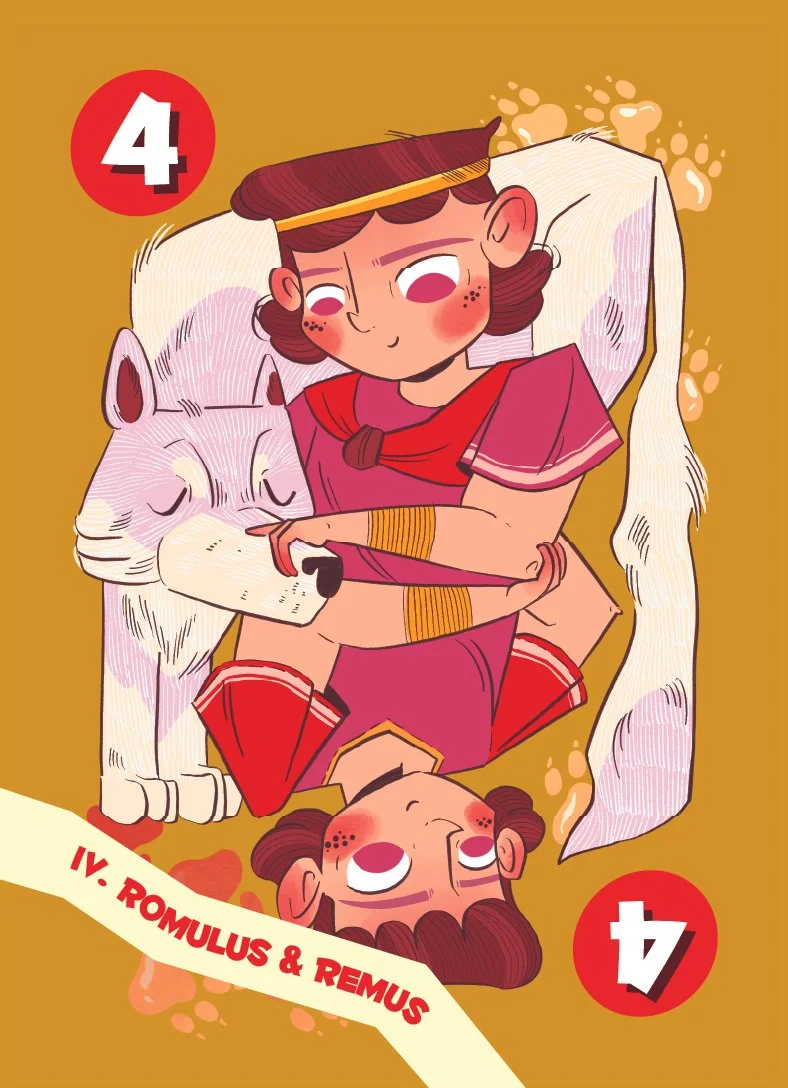
Romulus and Remus, Twin Builders of Rome
The story of Romulus and Remus is recorded in the History of Rome (called in Latin Ab Urbe Condita, or From the Founding of the City) by the Roman writer Livy. According to Livy, the twins were the children of the god Mars, and because of the circumstances of their birth were abandoned by the river Tiber as babies (adults may read more about this at their local library). Their cradle washed down the river, and they were found and rescued by the so-called She-Wolf. A shepherd happened by and brought them them home to raise as his own.
In their youths, the boys acted like ancient Robin Hoods. They stole money back from thieves and brigands that stalked the roads and distributed it amongst the other shepherds. In doing so, they built up a lot of goodwill among the people. This led to their eventual recognition by their grandfather, who, as it happened, was the rightful ruler of a city named Alba. From here, Romulus and Remus decided to build their own city, which they planned to be greater than all those around it.
Together, they built the city of Rome. As the walls were nearing completion, Remus jumped over them in fun. Romulus, furious, struck down his own brother, saying that the same fate would befall any others who came over his walls. Romulus would end up giving his name to the city the brothers founded: the Eternal City of Rome.

Mount Vesuvius, Ancient Cataclysm
Volcanic eruptions have exerted a powerful influence over the Mediterranean throughout history. A volcanic eruption on the island of Thera likely undid the power of the Minoans, an early civilization on the island of Crete. Mount Vesuvius is a part of that long tradition of historic eruptions.
Thanks to the careful notes of a Roman named Pliny the Younger, we know that the eruption of Mount Vesuvius that destroyed the city of Pompeii occurred sometime in the fall of 79 CE. Pliny watched the eruption as his uncle, the appropriately named Pliny the Elder, attempted to rescue people caught in the eruption. The eruption was unexpected, and while it was very destructive, it also froze a snapshot of Roman life in place. Archaeologists have been able to uncover a lot of information about ancient Roman life by studying the ruins of Pompeii.
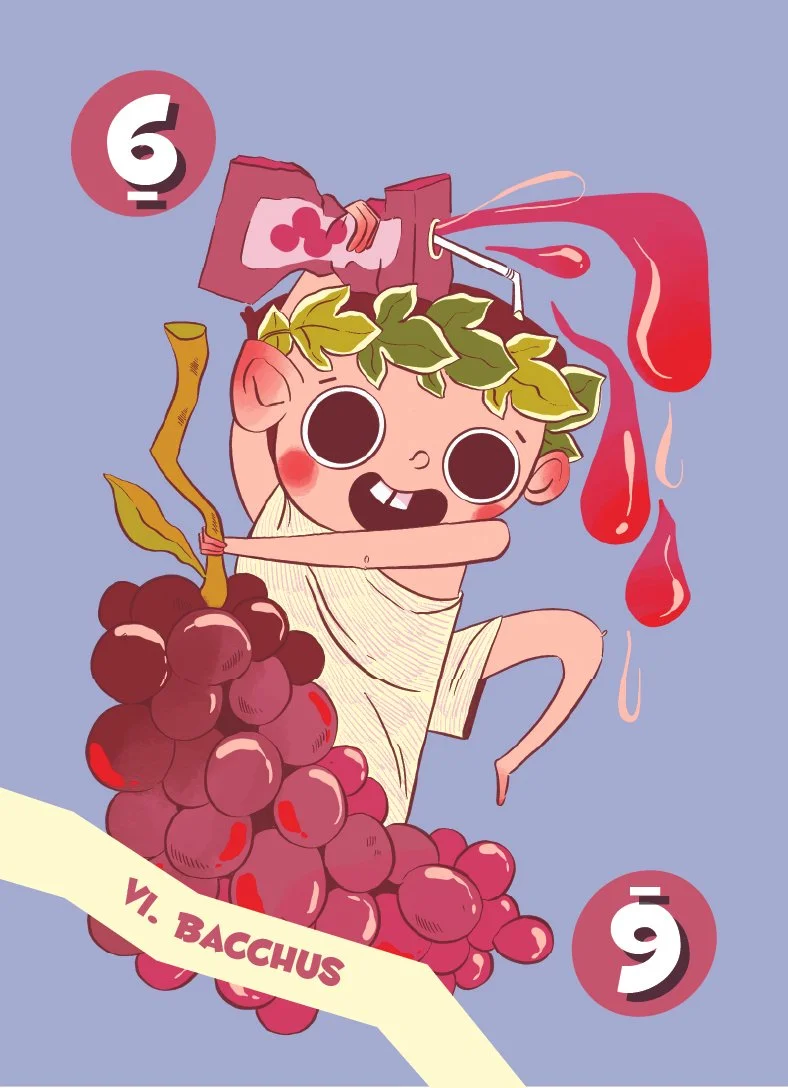
Bacchus, God of Juice Boxes and General Silliness
Bacchus, known to the Greeks as Dionysus, was associated with wine and the cycle of death and rebirth involved in the cultivation of grapes. He carried a pinecone-topped staff called a thyrsus (though some modern scholars argue that the pinecone we see in art may actually be an artichoke) and rode in a chariot driven by wild animals, most often big cats. His identification with exotic animals is likely due to the fact that in ancient mythology Bacchus was a foreign god, from a place called Mount Nysa, and traveled to Hellas (the ancient name for the area that would roughly become modern Greece) later. Bacchus is the subject of some of the most beautiful and well-preserved ancient mosaics, and he is sometimes shown riding on big cats.
Bacchus was a god that brought a lot of good to humans, and today he remains the patron deity of college undergraduates. He wasn’t a god to take advantage of, though, and when angered was among the most fearsome of the gods. He was known to turn people into animals when they displeased him, and turned more than one family member into snakes. Once, he was kidnapped by a group of pirates. They tried to tie his hands with ropes, but they always fell off his wrists. A grape vine began to grow on the mast, and vines spread over the ship. The panicked sailors jumped overboard, and Bacchus transformed them into dolphins. Only the helmsman, who recognized Bacchus’ divinity early, was spared.
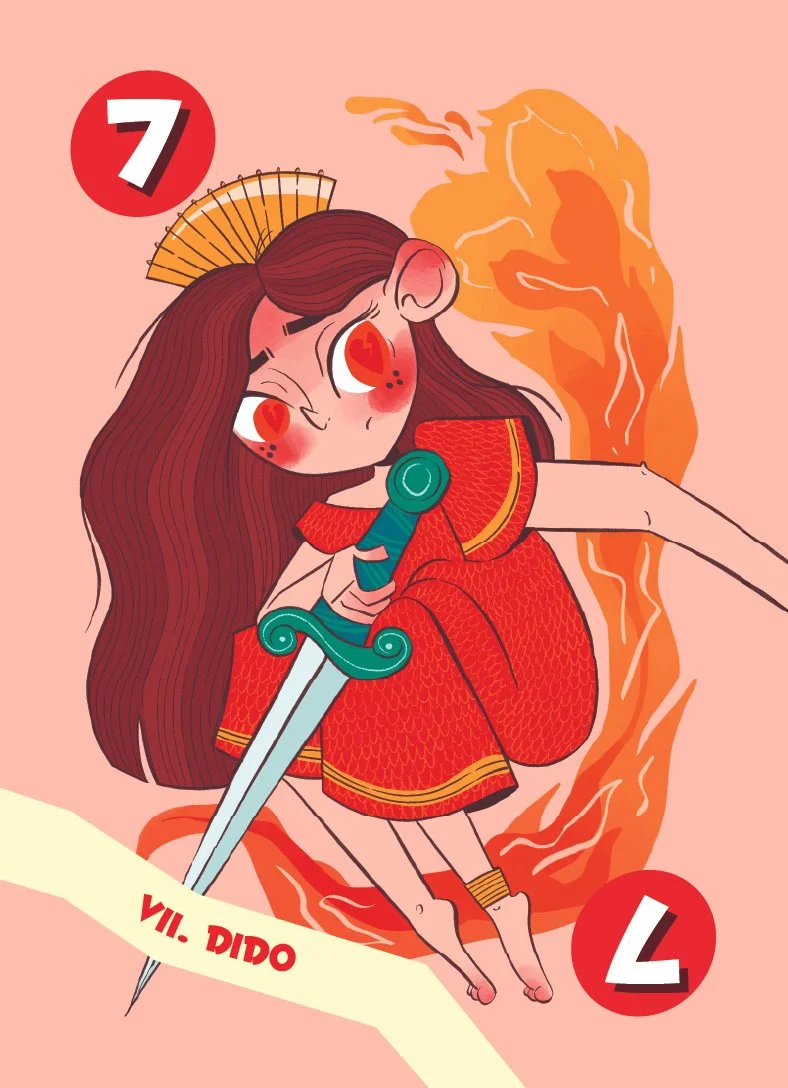
Dido, First Queen of Carthage
Dido was the mythical founder of a real city on the coast of Northern Africa called Carthage. Historical Carthage was a powerful maritime empire that was a major rival of Rome. In fact, the two civilizations were such fierce opponents that the Roman politician Cato the Elder would end all of his speeches with the phrase “Carthago delenda est,” which in English means, "and Carthage must be destroyed!”
The Roman poet Vergil tells Dido’s story in his poem, the Aeneid. His story provides a mythological foundation for the enmity (it means dislike) between the two empires. According to Vergil, the hero Aeneas came to Carthage on his way to settle the area the would one day become Rome. Dido was queen, the two fell in love and, depending on whose side you take, were or were not married.
While they seemed destined for a happy ending, the gods eventually reminded Aeneas of his destiny to travel to Italy and start the chain of events that would lead to the founding of Rome. Aeneas, realizing that he could not defy the gods, left Dido behind and went to Italy. Dido was heartbroken, and put a curse on Aeneas with her last breaths.
Did you notice? If you hold the Dido and Aeneas cards next to each other, they still reach out to each other today!
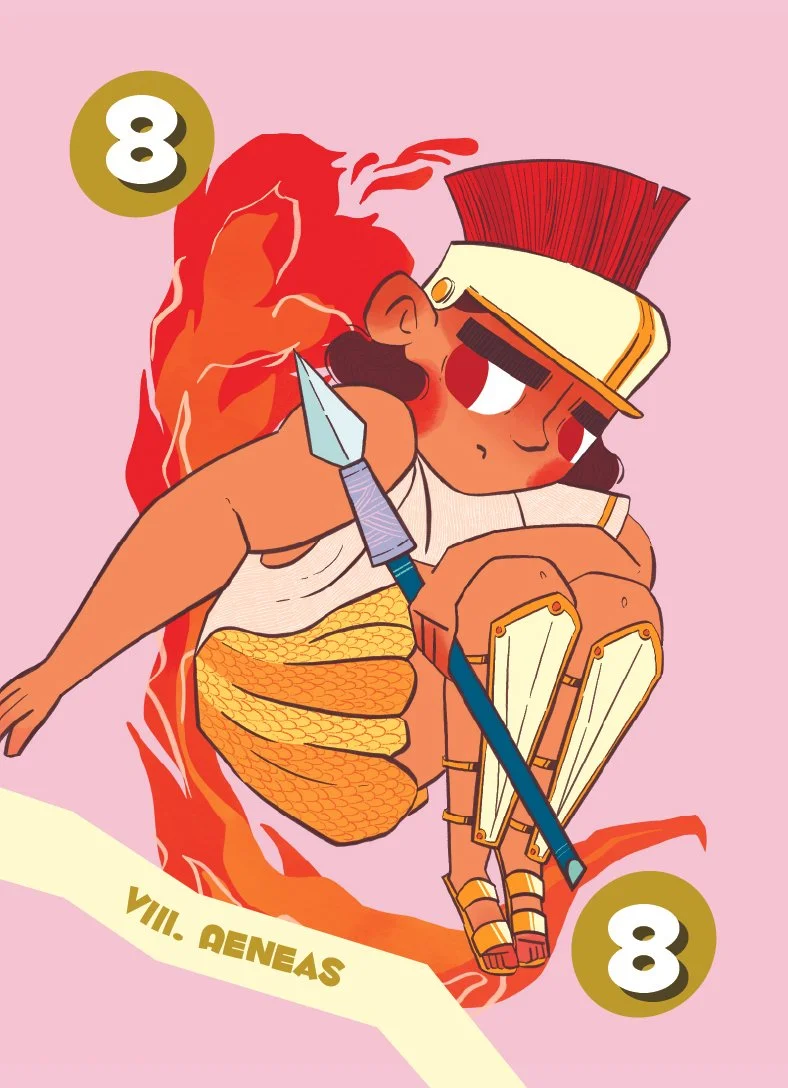
Aeneas, Forefather of Rome
Aeneas is the hero of the Aeneid, an epic poem by the Roman poet Vergil. The poem is often compared (and contrasted) with two other great epic poems: the Iliad and the Odyssey. There are many similarities between the poems, and Aeneas’ journey from Troy to Italy has much in common with the travels of other epic heroes.
Aeneas himself was not a Roman. He was one of the few Trojans that managed to escape the city of Troy after the Greeks entered and attacked the city in the wooden horse. With the city burning around him, Aeneas carried his elderly father out of town on his back. He also managed to save his young son, but his wife gets separated from them in the chaos. His dedication to his father was considered one of his greatest qualities by the Romans, who thought of Aeneas as the height of the Roman quality of pietas.
While Aeneas is considered one of the forefathers of Rome, he didn’t actually found the city. That job would go to Romulus and Remus!
Final fact: Augustus Caesar would claim to be related to Aeneas (and therefore Aeneas’ mother, Venus) in an attempt to portray himself and his uncle Julius as divine.

The She-Wolf, Adopted Mother of Romulus and Remus
Like many other cultures, the Romans had their share of stories about babies being lost and found. The most significant, no doubt, would be the story of Romulus and Remus. The babies were abandoned on the shores of the river Tiber to be swept off by the current, but were rescued at the last moment by the She-Wolf. She was only called lupa, the Latin word for wolf, in the story as it told by Livy in his History of Rome. The brothers were found by a shepherd shortly thereafter, and go on from there to found the city of Rome.
The She-Wolf’s part of the story is rather short, but she had a big impact on the Roman imagination. She was a constant subject in art, and was often shown in the midst of nursing the babies Romulus and Remus. There is a good deal of significance in the image, which was so important to the Roman mythos that it appeared on coins. If you asked a Roman child “were you raised by wolves?” they would take it as a compliment!
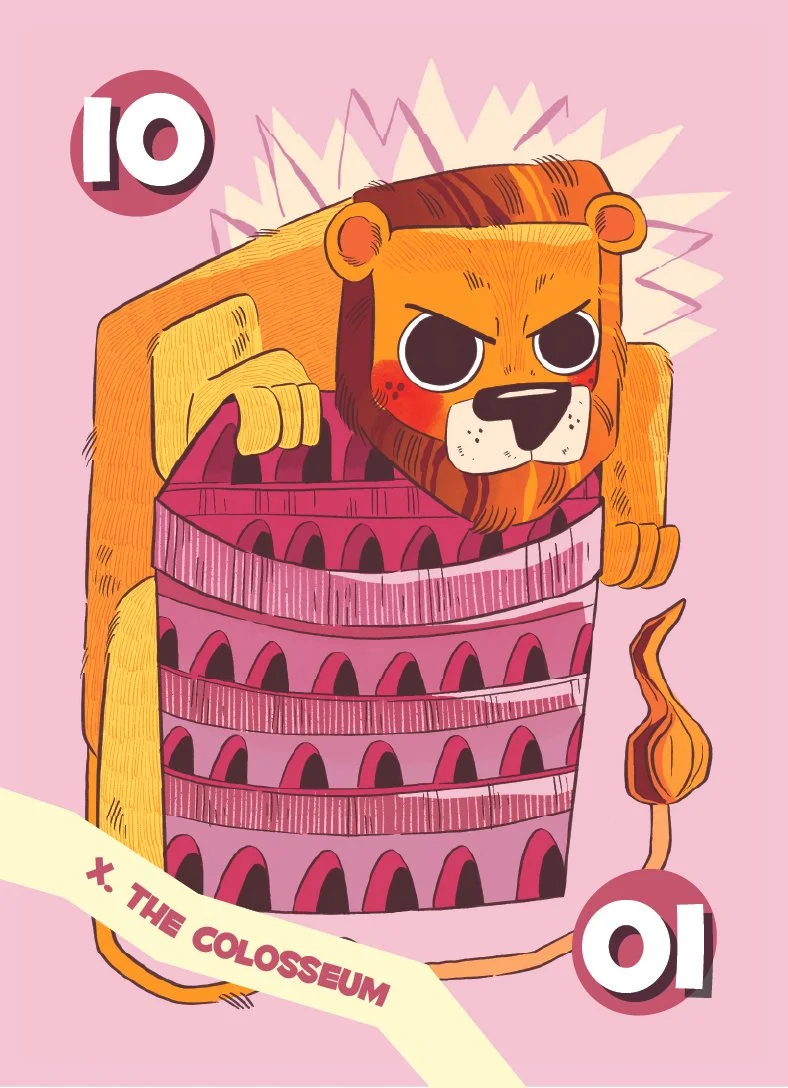
The Colosseum, The Great Arena
The Colosseum was a tremendous stone stadium built in Rome under a series of emperors, but begun under the Emperor Vespasian. The amphitheater-which means the seats surround the performance area-could hold around 50,000 people (or more, depending on who you ask). All sorts of events took place here, including gladiatorial fights and wild animal fights. Prominent politicians looking to make a name for themselves could put on elaborate, expensive productions to garner support from the people of Rome. At one time, it was even possible to flood the arena to stage naval battles.
Have you ever wondered about the difference between coliseum and Colosseum? It’s easy to misspell the name of the famous one in Italy! It gets easier when you learn that the Colosseum was named for a giant status-or Colossus-that stood outside it. The statue has been lost to time, but it was reportedly a statue of the Emperor Nero as the Sun itself! What a sight!
Final fact: the Colosseum had a system of ticketing through tokens called tesserae. They even corresponded to numbered seats in the stadium!
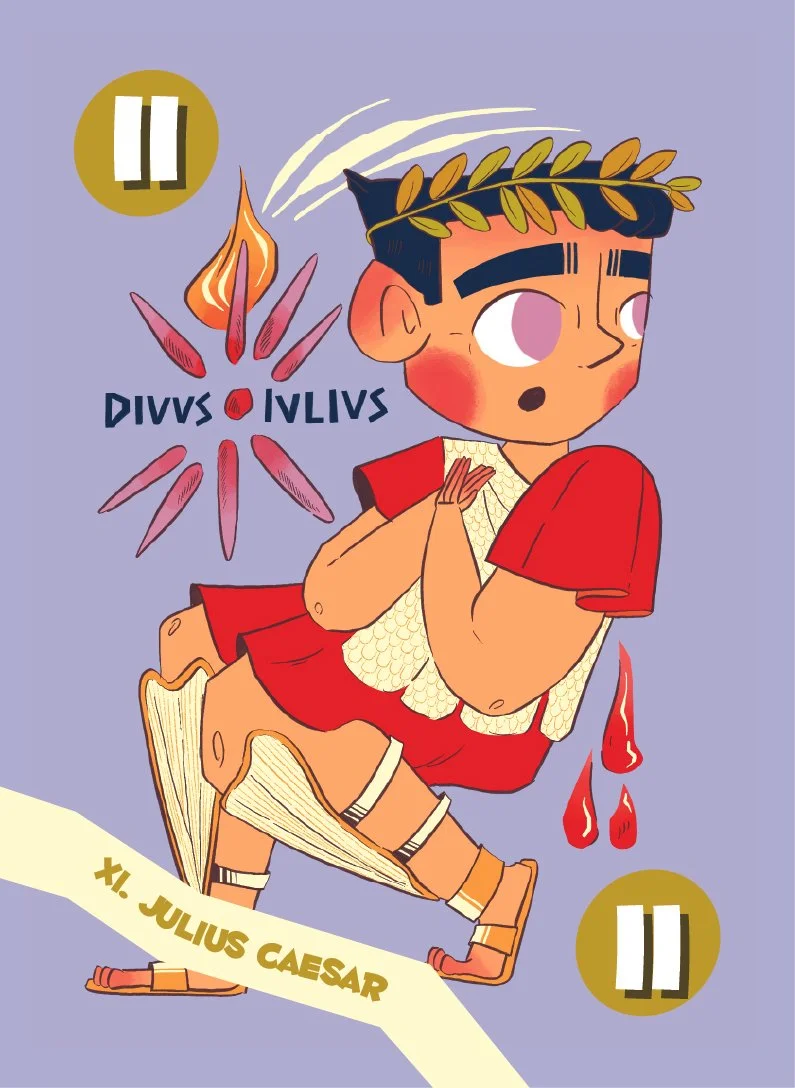
Julius Caesar, The End of the Republic
Julius Caesar is one of the best known figures of history. His life has been the subject of countless books, movies, television shows, and even comic books. He is perhaps best known for his military genius, which is undeniable. To secure his position as the undisputed master of Rome, he had to defeat Gnaeus Pompeius Magnus-Pompey the Great. He did so, but only after a long and costly civil war that is memorialized in an epic poem called Pharsalia.
Many people, especially from the aristocracy of Rome, saw Julius Caesar not as a great leader but as a threat to the Roman Republic. When Caesar was named Dictator for Life, his power was solidified and it was clear that Rome had fallen under the control of one person. In a final attempt to restore the Republic, the Senators of Rome assassinated Julius Caesar on the Ides of March, March 15th, 44 BCE. His assassination is recorded in The Lives of the Caesars by the Roman author Suetonius.
Some time later, when Julius’ nephew August held funeral games (it was customary) for his uncle, a great comet appeared in the sky and was visible, according to Suetonius, for seven days. It was generally believed that the comet represented Julius’ ascension to divinity-he had become a god.
Final fact: Augustus Caesar produced coins with an image of the comet and the words “Divus Iulius,” or “Divine Julius.” These coins were a form of early propaganda meant to promote the idea of Augustus’s own divinity. The comet from the coin is reproduced on this card!
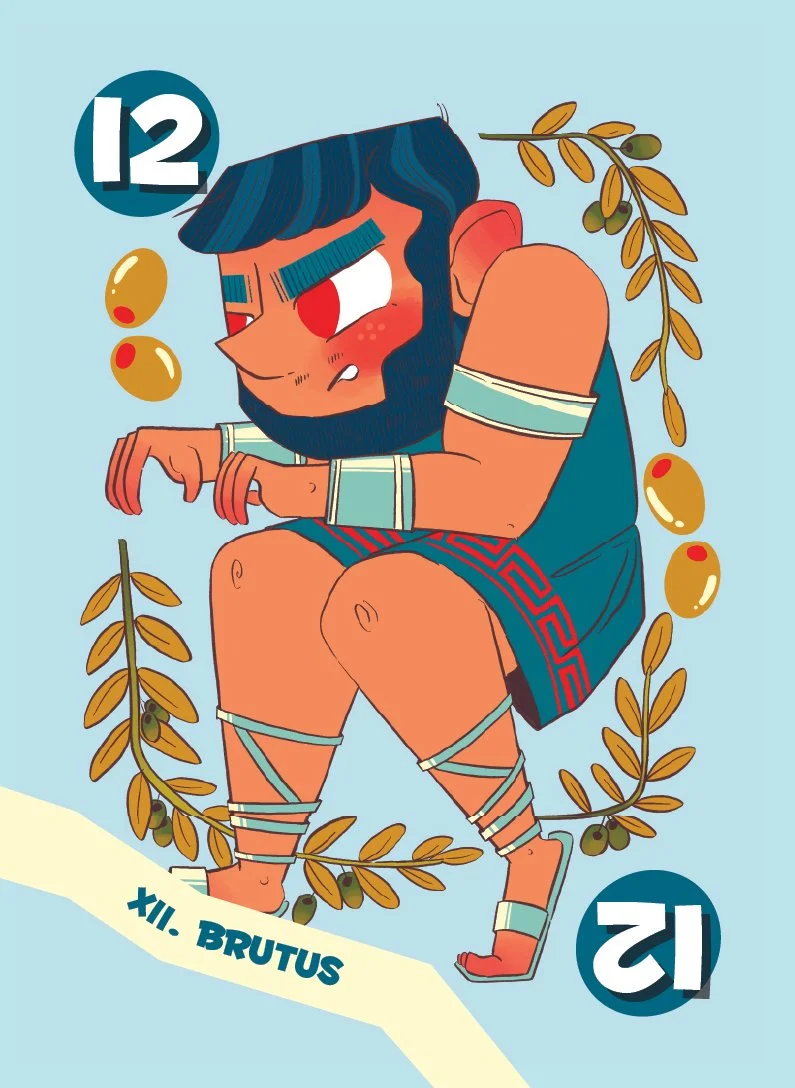
Marcus Brutus, The End of Caesar
Marcus Junius Brutus was a wealthy senator of Rome during Julius Caesar’ rise to power. He, along with several other senators, ambushed and assassinated Julius Caesar in the Curia of Pompey on the Ides of March. March 15th, of 44 BCE. This was an appropriate place for the deed, as Caesar’s power was solidified by his defeat of Pompey in the Roman civil war.
Brutus was not really the treacherous figure we often think of today. He has a reputation for being sneaky, but his opposition to Julius Caesar was open, and he fought against Caesar in the civil war. He has a minor role in Lucan’s Pharsalia, an epic poem that recounts the horrors of civil war.
Final fact: Most people think of Caesar’s last words as being ,”et tu, Brute?” (“even you, Brutus?”) but this quote is an invention by William Shakespeare in his play, Julius Caesar. Suetonius, an ancient biographer of the Caesars, gives the quote as, “Καὶ σύ, τέκνον” (kai su, teknon?), A Greek phrase that means something along the lines of, “Even you, child?” or perhaps, “even you, little boy?” Even this is doubtful, though, and many other versions of the story exist.

The Sacred Chickens, Heralds of Victory
It’s no secret that the Romans were an extremely warlike people. Unlike the Greeks, who rarely built temples or held festivals for Ares, the Romans were big fans of the their war god Mars. The Romans built a tremendous empire through conquest, and their logistical and tactical capabilities allowed them to run roughshod over (most) of empires of antiquity. It may be a surprise, then, to learn that the real secret to their military success was the regular consultation of the all-powerful sacred chickens.
To be clear, there wasn’t a single group of “Sacred Chickens” being pampered on velvet pillows in Rome. Sacred chickens were chickens that accompanied Roman armies on campaign and could be consulted for fortunetelling purposes. The pullarius, or chicken-keeper, would offer the chickens food before a battle. If they ate well, then the battle would be a success. If they did not, it was a bad sign, and the fight should be avoided.
Final fact: A roman naval commander named Publius Claudius Pulcher once consulted the chickens before a battle. When they refused to eat, he famously shouted, “If they won’t eat, then let them drink!” and threw the chickens overboard. He lost the battle and was charged by the Romans with impiety, leading to a tremendous fine.